Children recognize patterns earlier than expected.
Seeing children recognize familiar words and signs led Doman to think about reading as visual recognition before a traditional school lesson.
A story that starts with a simple observation: very young children can recognize more than we often
expect when information is presented clearly, briefly, and repeatedly.
In his books, Glenn Doman describes observations of very young children recognizing familiar words in advertising, signs, and other everyday messages. That raised a question: if they could recognize those words, what might happen if written language were presented deliberately, large, clear, and often?
Seeing children recognize familiar words and signs led Doman to think about reading as visual recognition before a traditional school lesson.
The published family program organizes reading in stages. It begins with individual words and moves toward word pairs, sentences, and small books. Sessions are brief and the adult presents the material.
The math approach starts with visual quantities before relying only on symbols. It later introduces relationships, operations, and numerals. The idea is for the child to see the quantity first and then its written representation.
The books include family accounts reporting early word recognition, enjoyment of the sessions, and progress at different paces. Those experiences helped expand the work into mathematics and other areas of knowledge.
Families describe young children beginning to recognize words that were presented often.
The authors emphasize brief, positive sessions without turning them into a test.
Family questions about other areas helped drive the development of the math program.
Each path progresses differently, but both depend on knowing what was presented, what should be repeated, and when it is time to move forward.
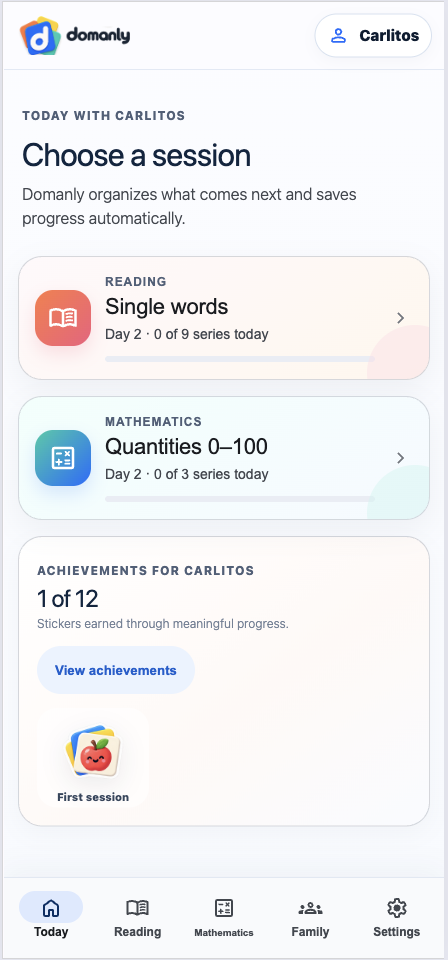
Domanly keeps that progression organized and lets families add vocabulary that is meaningful to them.
Explore Reading in Domanly ›Domanly keeps the stage and progress so every session continues from the right point.
Explore Math in Domanly ›Words that come in and out. Series that need repetition. Different stages in reading and math. Independent progress for each child. All of that can quickly turn into notes, sheets, and calendars.

Domanly presents this history to explain the program’s origin and logic. Cases described in the books are experiences reported by their authors and families. They should not be interpreted as guaranteed outcomes or as medical or therapeutic advice.